How to Choose an MVP Development Company
The questions to ask, the red flags to watch for, and how to compare quotes that look nothing alike, before you sign with a development partner.
Choosing a development partner is one of the first big decisions a founder makes, and it is surprisingly easy to get wrong. The problem is rarely that you hired a bad team. It is that you skipped the questions that would have exposed a mismatch before the contract was signed.
This guide gives you a process, the questions worth asking, and a way to compare quotes that look nothing alike.
Step 0: Define what "done" looks like
If you cannot describe your MVP, no agency can quote it accurately. Before you speak to anyone, write a one-page brief:
- Who the user is and the problem you are solving.
- The single core flow, written as a sentence.
- A list of must-have features, and a list of things you are deliberately not building.
- Platform (web, iOS, Android), key integrations and any regulated data.
- Your target launch date and your budget range.
If you need help with the feature list, start with how to prioritize MVP features. Giving every team the same brief is also what makes their quotes comparable.
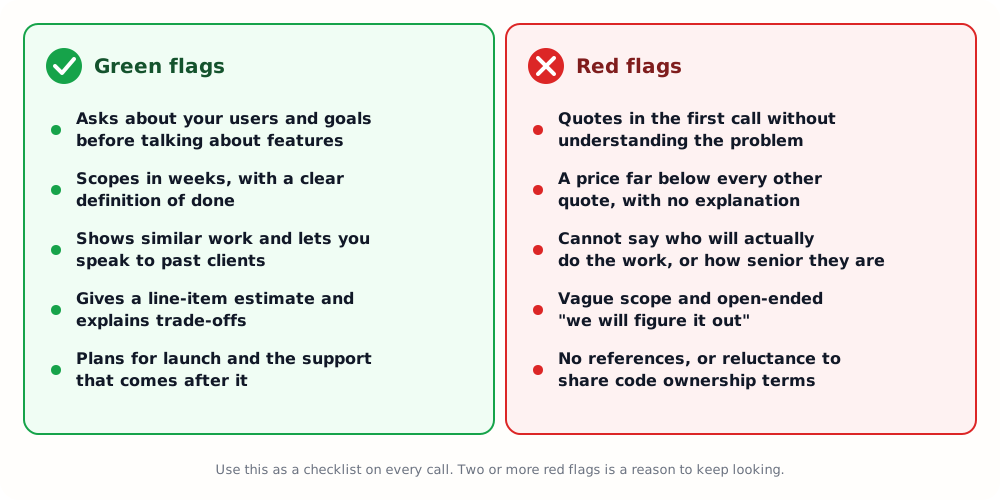
What good and bad look like
Twelve questions to ask every candidate
Process and communication
- "What do you want to know about my business before you estimate?" A good team asks about users, goals and constraints. A weak one asks for a feature list and sends a number.
- "What does a typical week look like?" Look for regular demos, a visible task board, and a named person who answers your messages.
- "How do you handle changes to scope?" Every project changes. You want a clear, fair process, not surprises.
- "What do you need from me, and how fast?" Delays on the client side are a leading cause of slipped timelines. A mature team tells you upfront.
Team and track record
- "Who will actually work on my project?" Ask for roles and seniority. The people in the sales call are often not the people writing the code.
- "Can I see similar work and speak to a past client?" Recent MVPs for early-stage companies matter more than large enterprise logos.
- "What went wrong on a past project, and what did you change?" Honest answers are a good sign. A team that has never had a problem is either very new or not being candid.
Technology and ownership
- "Why this stack for my product?" The answer should be about your needs, speed and hiring, not just what the team already likes. Our MVP tech stack guide shows what sensible defaults look like.
- "Who owns the code, designs and accounts?" You should own all of it, and hosting, domains and app-store accounts should be in your name from the start.
- "How do you handle security, testing and backups?" Look for automated tests, staging environments, access control and a recovery plan.
Commercials and after launch
- "What is in the quote, line by line?" Discovery, design, development, testing, project management and deployment should all be visible. See our cost guide for typical ranges.
- "What happens after launch?" Ask about a warranty period for bugs, ongoing support options and how handover works if you later hire your own team.
How to compare quotes that look nothing alike
You will probably receive quotes that vary several times over. That spread is a signal, so investigate it.
- Line up the scope. Check that each quote covers the same features, platforms and integrations. A lower quote often means something is quietly missing.
- Check the team. A lower price can mean a smaller team, fewer senior people, or scope that shrinks once the contract starts.
- Compare the timeline. A big gap in weeks usually reflects different assumptions about testing and design, not different speed.
- Ask for the assumptions. The best quotes list what they assume about your inputs, such as how fast you will respond and what is out of scope.
The cheapest quote is rarely the cheapest outcome. The most expensive is not automatically the best either. Pick the team whose questions made your idea clearer.
Choosing the engagement model
| Model | Best for | Watch out for |
|---|---|---|
| Fixed price | A well-defined, stable scope | Change requests, and pressure to cut corners |
| Time and materials | Evolving products and discovery-heavy work | Needs a cap or milestones to control spend |
| Dedicated team | Ongoing product work after the MVP | Overkill for a first build |
| Freelancers | Small, clearly bounded tasks | You become the project manager |
What to put in the contract
- Full ownership of source code and design files, transferred on payment.
- Milestones tied to working software you can see, not only to dates.
- A confidentiality clause and clear terms for third-party licences.
- A warranty period for defects after launch.
- A handover plan: documentation, credentials and a walk-through of the code.
Reduce risk with a small first step
If you are unsure, start with a short paid discovery phase, usually one to two weeks. You get a scoped plan, designs and a realistic estimate, and you learn what working together is like before committing to the full build. If the fit is wrong, you have lost little, and you keep the documents.
The takeaway
Hire for fit, not for the lowest number. Give each team the same brief, ask the twelve questions, and trust the partner who pushes back thoughtfully on your scope. A good development company will help you build less, and learn faster, than you came in planning to.
At Srutved we work with early-stage founders on focused MVPs. If you would like to talk through your idea, get in touch.
Tags
Keep reading