
Best Tech Stack for an MVP in 2026
An opinionated, boring-on-purpose stack for web and mobile MVPs: what to pick, what to skip, and why speed of change beats raw performance.
Choosing a tech stack can swallow weeks of a young startup's life. Founders read comparison posts, argue about frameworks and worry about scale that may never come. The uncomfortable truth is that for an MVP, most reasonable stacks will work, and the best one is usually the one that lets you change the product fastest.
This is an opinionated default for 2026: boring on purpose, widely supported and easy to hire for. We explain the reasoning so you can adapt it to your situation.
Five principles before any tool names
- Optimise for speed of change, not raw performance. Your product will be rewritten in places several times. A stack you can change quickly beats one that is theoretically faster.
- Pick what you can hire for. Popular tools mean more developers, more tutorials and fewer surprises. A rare language is a hidden hiring cost.
- Use one language where you can. TypeScript across front end and back end means one skill set, shared types and fewer hand-offs.
- Buy commodity features. Authentication, payments, email and storage are solved problems. Rent them.
- Postpone scale decisions. A well-chosen managed database and hosting platform will carry you a long way before architecture becomes the bottleneck.
The default stack at a glance
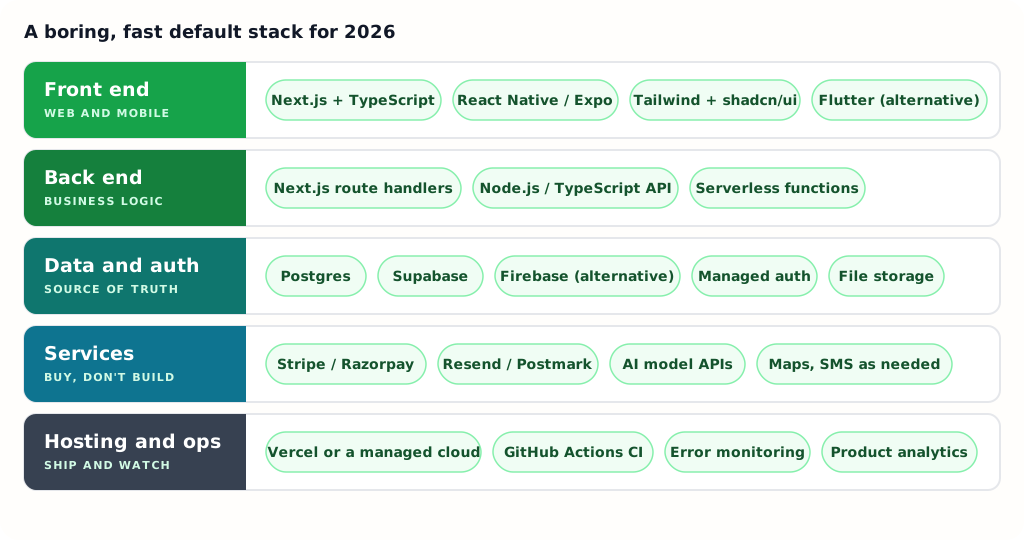
Front end: Next.js and TypeScript
For a web MVP, Next.js with TypeScript is a strong default. It is built on React, the largest front-end ecosystem, and it gives you routing, server rendering, API routes and good defaults for performance and search visibility in a single framework. TypeScript catches a whole class of mistakes before users do.
Pair it with a utility-first CSS framework such as Tailwind and a component library such as shadcn/ui, so that you spend your time on product behaviour and not on buttons.
Reasons to choose differently: if your team is already expert in Vue, Svelte or Rails, use what you know. Familiarity beats novelty at this stage.
Mobile: React Native or Flutter
If you need an app, a cross-platform framework lets one team ship to iOS and Android from a single codebase. Two sensible options:
- React Native with Expo works well if you already use React and TypeScript on the web. You share skills, and often some logic, and Expo adds a smooth workflow, builds and over-the-air updates.
- Flutter offers a single codebase with very consistent visuals across devices, and is a good fit when you want tight control over the interface and your team is comfortable with Dart.
Do you need an app yet? Often not. A responsive web app, or a progressive web app, is the cheapest way to reach real users. Go native when you genuinely need device features, offline mode or app-store distribution. Fully native, separate iOS and Android apps are rarely right for a first version.
Back end: keep it close to the front end
For many MVPs, route handlers inside Next.js or a small Node.js and TypeScript API are enough. They keep logic close to the interface, share types with the front end and deploy as one unit. Use a separate service only when a real need appears, such as long-running jobs, heavy data processing or a team that prefers another language.
For work that must not block a request, such as sending emails, processing uploads or calling slow third-party services, add a background job queue or serverless functions rather than doing it inline.
Database and authentication
Start with a relational database. Postgres is the safe default: reliable, flexible, and well understood. Managed platforms such as Supabase give you Postgres together with authentication, file storage and an API in one place, which removes a surprising amount of setup. Firebase is a capable alternative, particularly for mobile-first products with real-time needs, though its data model and pricing behave differently from SQL.
Never write your own password handling. Use a managed authentication service with social login and multi-factor options where you need them.
Whatever you choose, set up automatic backups and test a restore before launch.
Services you should rent, not build
| Need | Typical choices | Note |
|---|---|---|
| Payments | Stripe, Razorpay, PayPal | Pick based on the countries and currencies you serve |
| Transactional email | Resend, Postmark, SendGrid | Set up SPF and DKIM early for deliverability |
| Search | Postgres full-text, Algolia, Meilisearch | Start with the database you already have |
| AI features | Hosted model APIs | See how to build an AI MVP |
| Analytics | PostHog, Google Analytics, Mixpanel | Track the one or two metrics that define success |
| Error monitoring | Sentry or similar | Know about bugs before your users tell you |
Hosting and operations
Use a managed platform. Vercel suits Next.js particularly well and gives you preview deployments for every change. For apps that need more control, a managed container or cloud service on AWS, Google Cloud or Azure works too. Add three things on day one: a continuous-integration pipeline that runs your tests, error monitoring, and a staging environment that mirrors production.
Avoid Kubernetes, microservices and custom infrastructure for an MVP. They solve problems you do not have yet and cost real time to run.
What to skip for now
- Microservices. A single well-organised application is easier to build, test and change.
- Custom authentication or payments. High risk, no differentiation.
- Premature performance tuning. Measure first. Most early bottlenecks are an unindexed query.
- Multiple databases. One Postgres instance covers most needs.
- Trendy tools you have not used. Novelty carries risk, and an MVP already has plenty.
Quick picks by product type
| Product | Suggested stack |
|---|---|
| SaaS dashboard or marketplace (web) | Next.js, TypeScript, Postgres (Supabase), Stripe, Vercel |
| Consumer mobile app | React Native with Expo, Supabase or Firebase, push notifications service |
| Content-heavy site or blog | Next.js with a headless CMS or Markdown, deployed statically |
| AI assistant over your data | Next.js, Postgres with a vector extension, hosted model API |
| Internal tool | Consider low-code first (see no-code vs custom code) |
A short checklist for deciding
- Does my team already know this tool well?
- Can I hire people who use it, in my region and budget?
- Is it popular enough that problems have documented answers?
- Can it do what the MVP needs today, without heroic effort?
- Could I replace it in a few weeks if I outgrow it?
If you can answer "yes" to most, you have a good enough stack. Move on to building.
The takeaway
A good MVP stack is boring, popular and managed. It lets a small team ship in weeks, change direction cheaply and spend its effort on the parts of the product that make customers care. Pick it quickly, write it down in your plan (see how to build an MVP in 4 weeks), and revisit it only when the product tells you to.
If you would like a second opinion on your stack or your scope, talk to Srutved.
Tags
Keep reading