How to Build an AI MVP Without Training a Model
Most AI products do not need a custom model. How to ship an AI-powered MVP with existing APIs, retrieval, evaluation and a cost ceiling.
Every startup deck now has "AI" somewhere on slide three. Founders often assume that means collecting data, hiring machine-learning engineers and training a model for months. For most products that is exactly the wrong move.
Today the practical route to an AI-powered MVP is to use a model that already exists, give it your data at the moment of the question, and wrap it in the testing and cost controls that make it dependable. This guide explains how that works, what to build, and the mistakes that sink first AI products.
You almost certainly do not need to train a model
Calling a hosted language model through an API, from providers such as OpenAI, Anthropic or Google, gives you a capable model on day one, with nothing to train or maintain. For an MVP the question is rarely "can the model do this?" and more often "can we make it do this reliably, for our users, at a cost we can afford?"
Training or fine-tuning your own model starts to make sense later, when you have proven demand, collected real usage data, and have a clear reason that a general model is not enough, such as cost at scale, latency, or a narrow domain where accuracy matters most.
What an AI MVP looks like inside
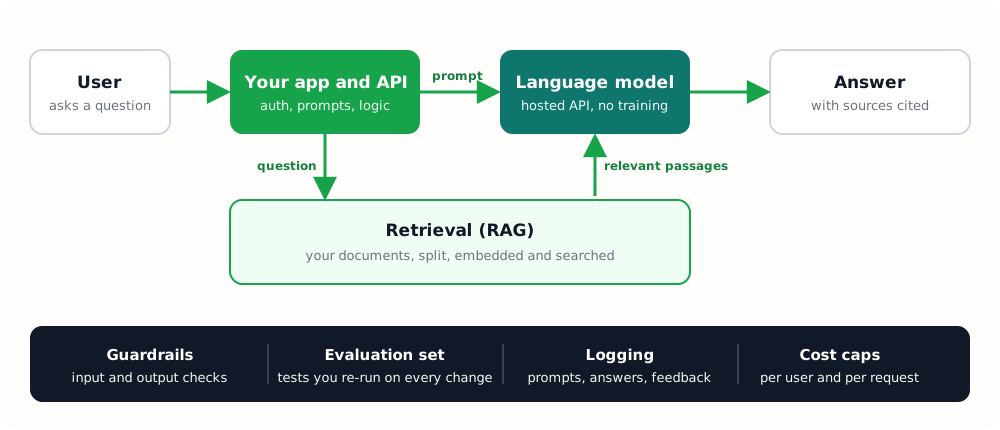
Most AI MVPs are made of the same parts:
- A normal web or mobile app with authentication, a database and a clean interface. This is still most of the work.
- A model API that does the language understanding or generation.
- Retrieval over your own content, when the answer depends on information the model does not already have.
- Guardrails, evaluation, logging and cost controls that turn a clever demo into a product.
Retrieval-augmented generation in plain English
A general model knows nothing about your customers' contracts, your product catalogue or your internal policies. Retrieval-augmented generation, or RAG, solves that without any training. The steps are:
- Prepare: split your documents into small passages and store them in a searchable index, often a vector database.
- Retrieve: when a user asks a question, search the index for the most relevant passages.
- Generate: send the question and those passages to the model, and instruct it to answer using only that material and to cite its sources.
The quality of your answers depends far more on the quality and structure of your documents than on which model you pick. Clean, current, well-organised source material is the most underestimated cost in RAG projects.
How to build it, step by step
1. Pick one narrow job
"An AI assistant for everything" is not an MVP. "Answers questions about our returns policy using our help centre" is. The narrower the job, the easier it is to test and to get right.
2. Do it by hand first
Take twenty real examples and run them through a model in a playground. If you cannot get good answers there, a full product will not fix it. This costs almost nothing, and it works like a proof of concept (see MVP vs prototype vs proof of concept).
3. Build an evaluation set before the product
Write 30 to 100 realistic questions with the answers you would accept. Run them after every change to the prompt, the model or the retrieval, and track the score. Without this you are guessing, and every improvement risks breaking something else. Teams that skip it tend to learn about problems from angry users.
4. Build the thinnest possible product around it
A simple interface, a login, a way to give a thumbs-up or thumbs-down on each answer, and a log of every request. The feedback buttons are not decoration. They are how you collect the data that makes version two better.
5. Add guardrails
- Ground the answers. Tell the model to use only the supplied context and to say "I do not know" when it is not there.
- Handle prompt injection. Users, and documents they upload, can contain instructions meant to hijack the model. Treat all model input as untrusted. The OWASP list of top risks for LLM applications is a good starting checklist.
- Protect data. Decide what personal or confidential data may be sent to a third-party model, and check each provider's data-retention terms.
- Keep a human in the loop for anything high-stakes, such as medical, legal or financial output.
6. Put a ceiling on cost
Model usage is billed by volume, so a bug or a heavy user can produce a surprising invoice. Set spend limits before you write the first prompt.
- Cap requests and tokens per user and per day.
- Limit loops in "agent" workflows, because a model that retries endlessly can run up costs quickly.
- Route simple tasks to smaller, cheaper models and keep the expensive one for hard reasoning.
- Cache repeated answers, and keep prompts and retrieved context short.
Model prices and limits change often, so check each provider's current pricing before you budget.
Timeline and cost
Published estimates for AI products cluster in a recognisable pattern: a proof of concept in two to four weeks, a first usable MVP in roughly six to twelve weeks, and a hardened production system over several months. Cost guides commonly place an AI MVP somewhere around $15,000 to $60,000, depending on scope, integrations and the quality of your data. Our cost guide explains what moves those numbers, and how to build an MVP in 4 weeks shows how a tight scope shortens the timeline.
Common mistakes
- Starting with the model, not the problem. Technology is not a use case.
- No evaluation. If you cannot measure quality, you cannot improve it.
- "Dumb" retrieval. Dumping a pile of unstructured documents into an index and hoping. Clean and chunk them with care.
- Over-trusting the output. Models can state wrong things confidently. Design the interface to show sources and let users verify.
- Ignoring unit economics. If each answer costs more than the customer pays, growth makes things worse.
- Building an agent when a single prompt would do. Complexity multiplies failure modes. Start with the simplest design that works.
When a custom model is worth it
Consider fine-tuning or training once you have evidence of demand and a specific limit with the off-the-shelf approach: costs that are too high at your volume, latency that is too slow, a specialised domain where generic models underperform, or data that cannot leave your own infrastructure. Even then, the evaluation set and logs you built for the MVP are what make that decision an informed one.
The takeaway
An AI MVP is a normal MVP with a model API inside and a lot of care around quality and cost. Choose one narrow job, test it by hand, build an evaluation set, ship a thin product, and measure everything. You will learn whether the idea works within weeks, and you will know exactly where to invest next.
Planning an AI-powered product? Talk to Srutved about scoping an AI MVP.
Tags
Keep reading