MVP Development Cost in 2026: What You'll Really Pay
Published estimates run from $15,000 to $250,000+. What actually moves the price, what a realistic budget looks like, and where founders overspend.
"How much does it cost to build an MVP?" is the first question most founders type into a search box, and the answers are famously unhelpful. One guide says $5,000, another says $250,000. Both can be right, because they are describing different products built by different teams.
This guide gives you the published ranges, explains the handful of factors that actually move the number, and shows how to build a budget you can defend. All figures are in US dollars and should be treated as orientation, not a quote.
The short answer: typical ranges
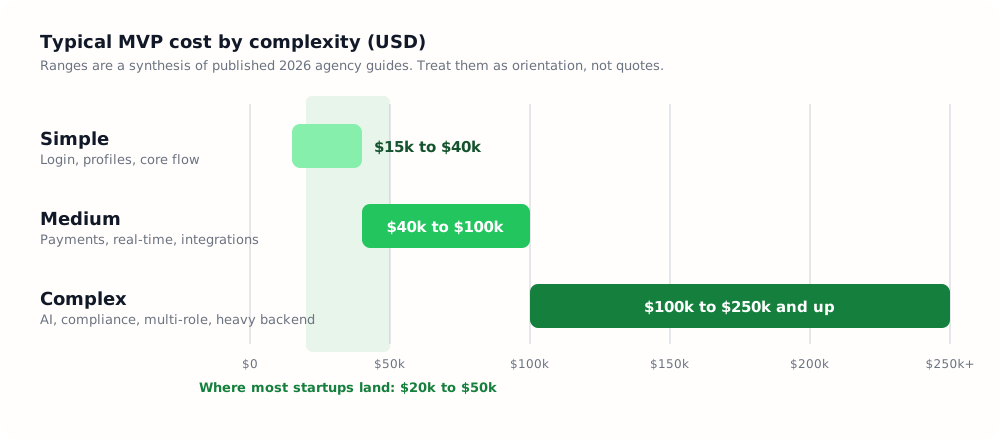
Across 2026 cost guides from software agencies, such as those from Metizsoft, Techtic and SolGuruz, a consistent picture emerges:
- Simple MVP, about $15,000 to $40,000. Sign-up, profiles, one core flow and basic admin.
- Medium MVP, about $40,000 to $100,000. Adds payments, real-time features or several third-party integrations.
- Complex MVP, about $100,000 to $250,000 and up. Advanced AI, heavy backend processing, several user roles, or compliance requirements.
Most startups end up spending somewhere between $20,000 and $50,000 on a first launchable version. The extremes, near $5,000 for a single-feature build and $250,000 or more for a regulated fintech or healthcare product, are real but rare.
What actually moves the price
Five factors explain almost all of the variation between quotes.
1. Scope: how many distinct things the product does
Cost grows with the number of features, but even more with the number of user roles and states. A product with a customer, a vendor and an admin is closer to three products. Cutting scope is the cheapest lever you have, and we cover how in how to prioritize MVP features.
2. Platform: web, iOS, Android or all three
A responsive web app is the cheapest route to real users. A cross-platform mobile app (React Native or Flutter) typically costs more than web but far less than two separate native apps. Native apps for both stores, with deep device features, sit at the top of the range.
3. Integrations and compliance
Every external system (payments, maps, messaging, CRMs, identity checks) adds design, build and testing time. Regulation multiplies it: published estimates suggest that meeting HIPAA requirements alone can add tens of thousands of dollars in infrastructure and documentation. If your sector is regulated, budget for it explicitly.
4. AI features
Using an existing model through an API is far cheaper than training your own. A production AI MVP is commonly quoted at roughly $15,000 to $60,000, with a proof of concept at the lower end. The part that surprises founders is the ongoing cost of model usage, which scales with traffic. We cover this in how to build an AI MVP.
5. Team model and location
Hourly rates differ enormously by region and by team type (freelancer, agency, in-house). Several guides estimate that working with a team in India can reduce cost by around 70 to 75% compared with an in-house US team for the same scope. Be careful: a lower rate with a slow, junior or poorly managed team can cost more in the end. See how to choose an MVP development company for what to check.
Where the money goes
A typical MVP budget covers the following. Exact percentages vary, so ask any prospective team to show you their own breakdown.
| Line item | What it covers | Where founders overspend |
|---|---|---|
| Discovery and design | Scoping, user flows, wireframes, UI design | Pixel-perfect visuals before the flow is validated |
| Engineering | Front end, back end, database, integrations | Custom-building what a service already does |
| QA and security | Testing, device checks, access control, backups | Rarely overspent, often under-funded |
| Project management | Planning, reviews, communication | Large process for a small team |
| Infrastructure and tools | Hosting, monitoring, email, analytics | Enterprise plans before you have users |
Costs people forget
- After launch. Hosting, monitoring, bug fixes, dependency updates and support. A common rule of thumb is to keep a monthly maintenance reserve, often in the range of 15 to 20% of the build cost per year. Treat that as a prompt to ask, not a rule.
- Accounts and fees. Apple and Google developer accounts, payment-provider fees, SMS and email volume, and map or AI API usage.
- Content and legal. Privacy policy, terms, and any seed content the product needs to feel alive.
- Iteration. The first version is never the last. Reserve budget for the changes that real usage will demand.
Five ways to spend less without cutting quality
- Cut scope before cutting quality. A smaller product built well beats a bigger one built badly.
- Start on one platform. Launch on web or one mobile platform, then expand when demand is proven.
- Buy commodity features. Use managed services for authentication, payments, email and storage.
- Validate before you build. A prototype and ten customer interviews cost far less than a wrong product. See MVP vs prototype vs proof of concept.
- Fix the scope and timeline, flex the features. A fixed budget with a prioritised backlog is safer than an open-ended scope.
How to build your own budget
- Write the core flow as one sentence and list the three to five features it needs.
- Decide the platform, and whether you need payments, AI or any regulated data.
- Place yourself in the simple, medium or complex band above.
- Ask two or three teams for a quote against the same written scope, with a line-item breakdown.
- Add roughly 15 to 20% contingency, and a maintenance reserve for the first year.
Fixed price, hourly or monthly: which to choose?
- Fixed price suits a well-defined scope. You get cost certainty, but changes mean change requests.
- Time and materials suits evolving products. You pay for effort and keep flexibility, so you need a good handle on progress.
- Dedicated team (monthly) suits ongoing product work after the MVP, not a first build.
The takeaway
A realistic first-version budget for most startups is in the tens of thousands of dollars, and it is driven by scope far more than by technology. If a quote sounds too good to be true, ask what has been left out. If it is far above your range, ask what could be deferred to version two.
Want a clear estimate for your idea? Share it with Srutved and we will outline a scoped MVP plan with a line-item budget.
Tags
Keep reading